

LEADING EOT CRANE MANUFACTURER
EOT Crane
EOT Cranes from 1 Ton to 100 Ton Capacity -Built for Heavy Duty Performance, Smooth Operation & Long-Term Reliability.
Years Experience
Installations
Certified
Service
EOT Crane Manufacturers in India
Ganesh Engineering Co. is a crane manufacturer based in Ahmedabad, Gujarat. For more than 22 years, we have been designing and building EOT (Electric Overhead Traveling) Cranes for Indian industry.
We have supplied over 500 cranes so far. Our clients range from steel plants and foundries to automobile companies and heavy engineering units. Our cranes lift anywhere from 1 ton to 100 tons.
Every EOT crane follows IS:807 and IS:3177 standards, and we manufacture it ourselves, in our own facility. Once delivered, you also get installation support, AMC (annual maintenance contracts), and spare parts as and when required.
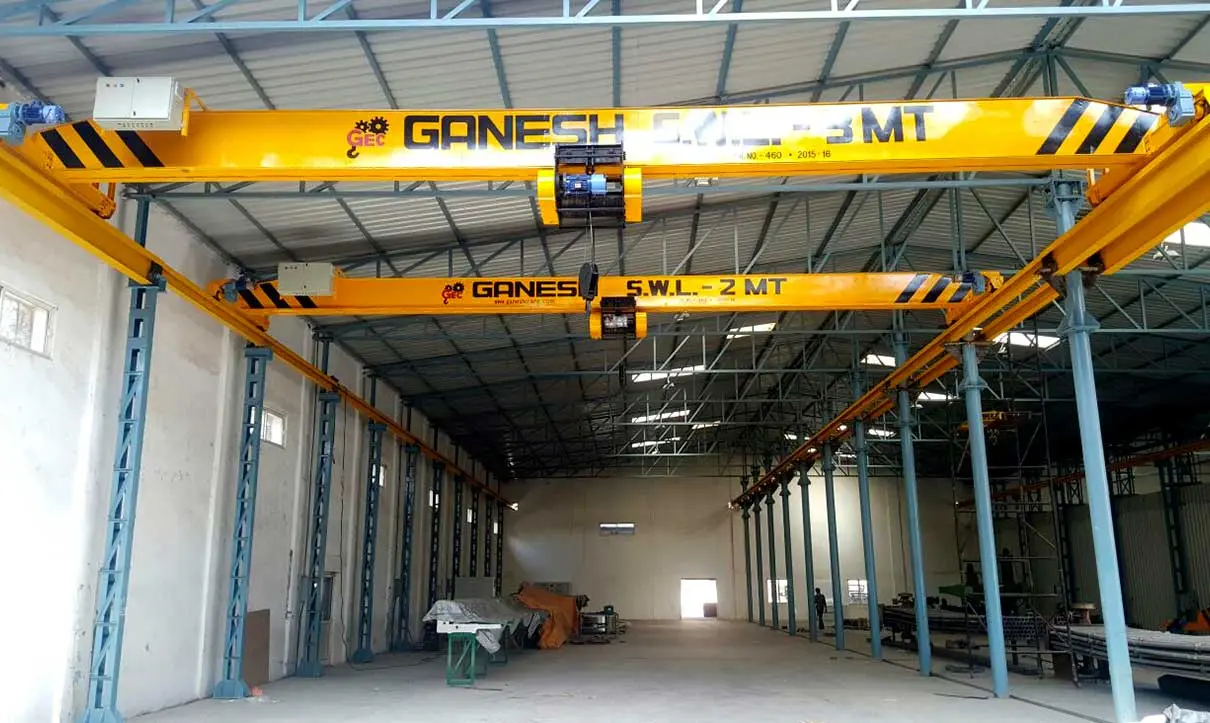
For normal, everyday lifting, a single girder crane usually does the job well. If your work is heavier and runs non-stop, a double girder crane is the better fit. Talk to our engineers, and they will help you decide what suits your factory.
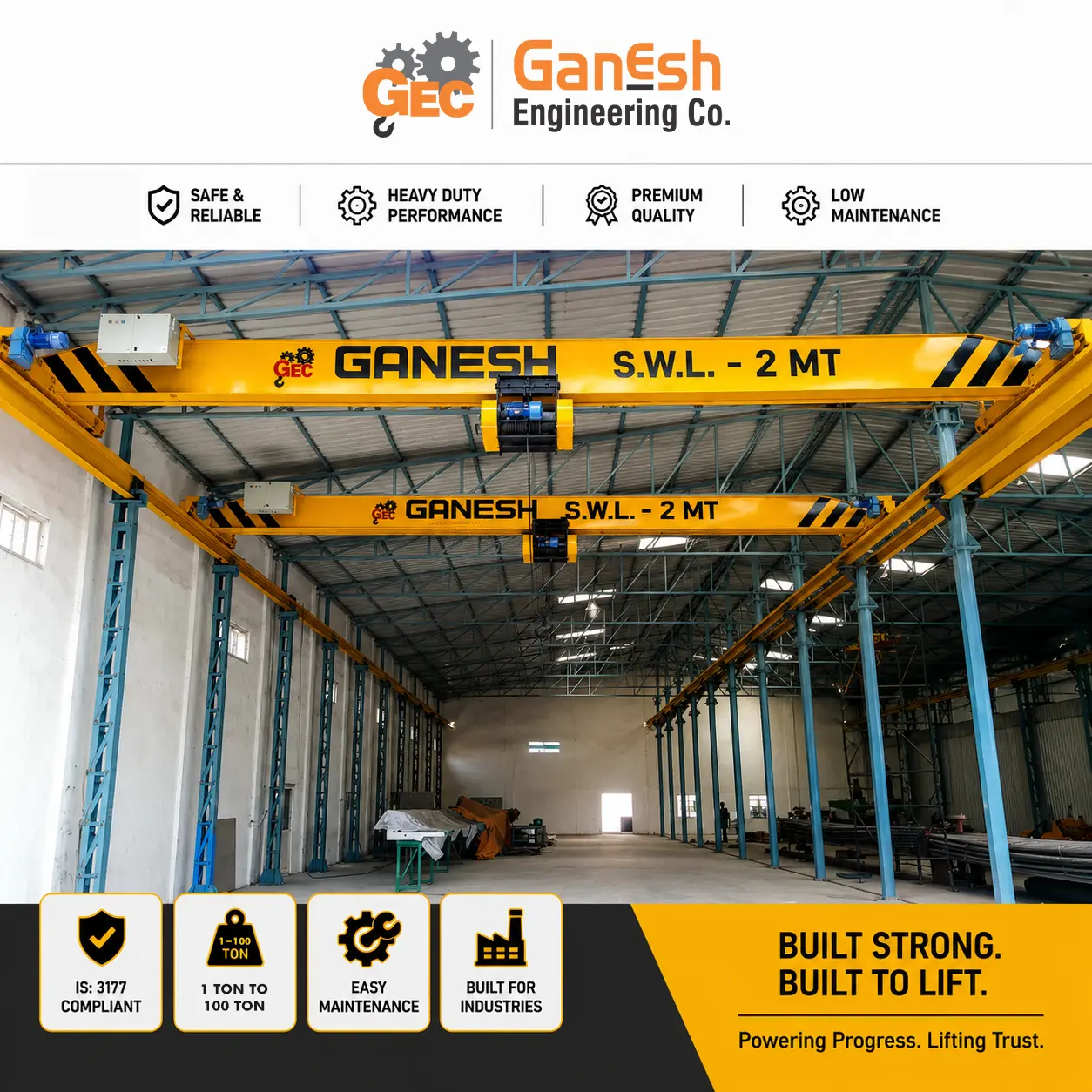
Technical Specifications
Specifications
| Parameter | Details |
| Span | 5 Mtrs. to 50 Mtrs. |
| Capacity | 1 Ton to 100 Ton |
| Duty Class | Class I to Class IV (M1–M8) |
| Design Standard | IS:807, IS:3177 |
| Operation Mode | Pendant Pushbutton / Radio Remote / Cabin |
| Power Supply | As per site requirement |
Standard Features
- Simple, optimum design ensuring minimum dead weight, wheel load, and easy maintenance
- Reliable and rigid structure with easy installation
- Higher motor efficiency for lower power consumption
- Fail-safe brakes on all motions — applied on power off, released on power on
- Limit switches on all motions for controlled operation
- Rubber buffers for protection against collision in case of limit switch failure
- Dustproof panel box with reputed make switchgear
- 110V control voltage for operator safety against electrical shock
- Electrical interlocking to prevent simultaneous operation of opposite motions
- C-Rail / I-Section type CT and pushbutton festoon system for long, trouble-free life
- Unbreakable, lightweight PVC pushbutton station
- Coupling-less LT, CT, and hoist motions up to 10 HP — less mechanism, less maintenance
- VFD in long travel motion for smooth start/stop and extended mechanism life
- In-house manufactured gearbox — all spare parts readily available
- Maintenance platform with handrailing along girder for safe crane servicing
Optional Features
- Radio Remote Control or Cabin Control
- Dual speed for all motions
- VFD on all motions
- Siren during crane travel
- Load cell with display for load weighing and overload protection
- Special dimension hooks
- Third-party branded gearbox options
- Drag chain festoon system
- Protective paint or specialized coating
Safety Features
- Safety features others don’t offer or offer at extra cost; ours are standard.
- Over lowering or over hoisting prevention limit switch.
- Hook safety latch.
- Overload relays.
- Travelling limit switch.
- Rubber buffer.
- Brakes in hoisting as well as C.T. & L.T.
- Main switch.
- On/Off switch in push button / Emergency stop.
- MCB / fuse.
- All 4-core cables with earth cable.
- Maintenance platform.
- Siren in a goliath crane.
- Anti-collision device when more than one crane is operating in the same bay.
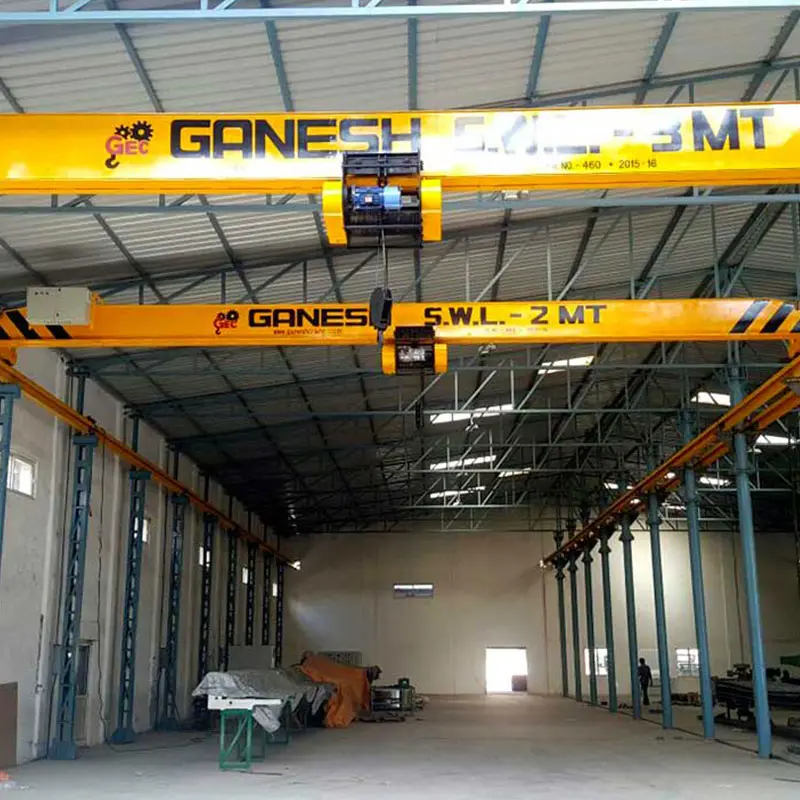
What is an EOT Crane?
An EOT crane, also called a bridge crane, runs on electricity and moves along a track fixed high up inside a factory, warehouse, or shed.
Because it works overhead, your shop floor stays clear below. Workers can move around freely, machines can be shifted, and materials can be stored without a crane getting in the way. That’s a real advantage over equipment that works at floor level.
An electric overhead traveling crane is built around three main parts:
Bridge — the horizontal beam that runs across the width of the building, moving on rails fixed to the shed or building columns
Trolley moves left and right across the bridge, carrying the hoist and positioning the load sideways
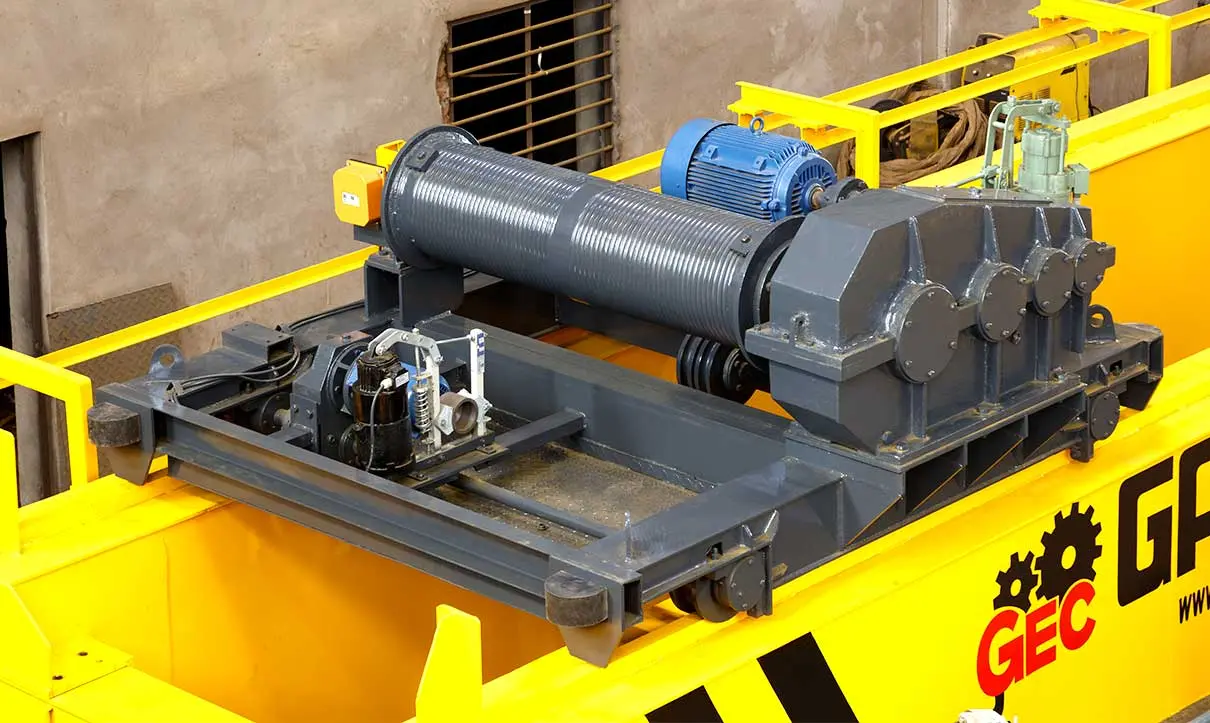
Hoist — fitted on the trolley, this lifts and lowers the load up and down
When should you use this type of crane?
Once a load gets too heavy for a forklift or chain block, usually above 1 ton, an EOT crane becomes the practical choice. It works especially well where heavy loads have to move repeatedly through the same area. Think of a rolling mill feeding stock to a press line, a foundry shifting molds and castings, or an assembly line passing parts between stations.
A mobile crane needs floor space and setup time before every lift. An overhead traveling crane doesn’t, which makes it a lot faster for factories that handle materials often through the day.
How Does It Work?
Hoisting Motion
The hoist raises and lowers the load. Most cranes use wire rope hoists here — they're compact, efficient, and hold a load safely even through long hours of use.
Cross Travel (Trolley Movement)
The trolley moves left and right along the bridge, so the load can be positioned exactly where it's needed — over a machine, a truck, or a work station.
Long Travel (Bridge Movement)
The bridge itself moves forward and backward on rails fixed to the building columns, reaching almost any point along the length of the shed.
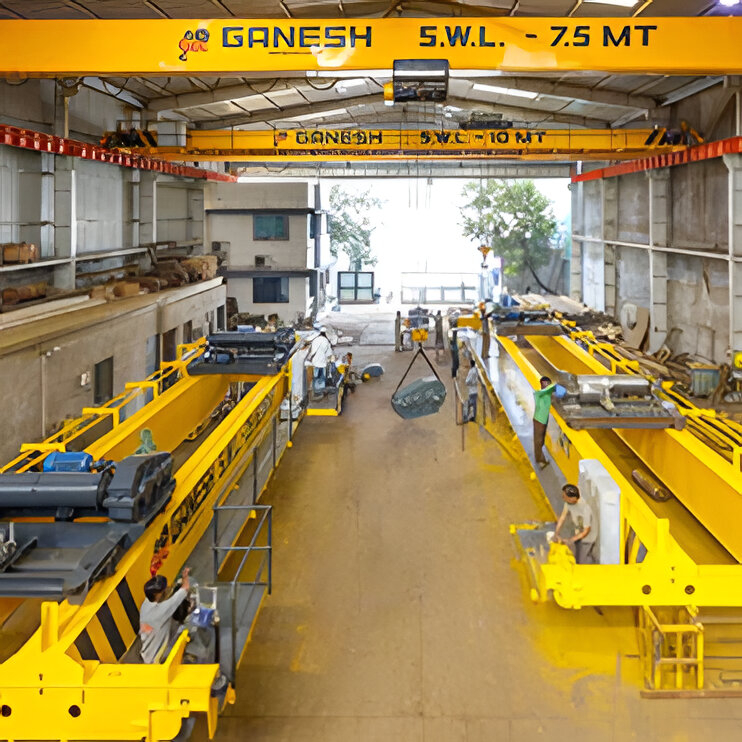
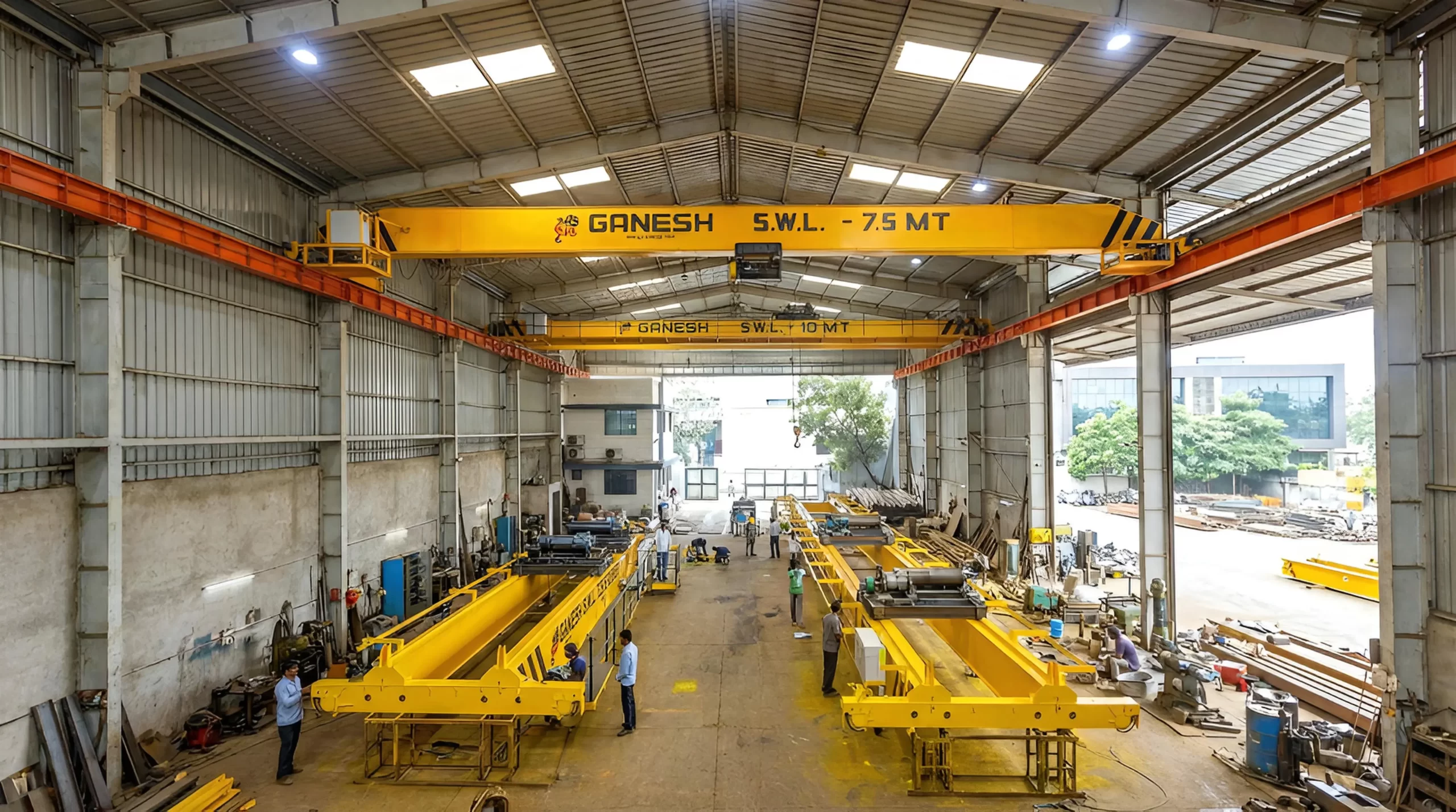
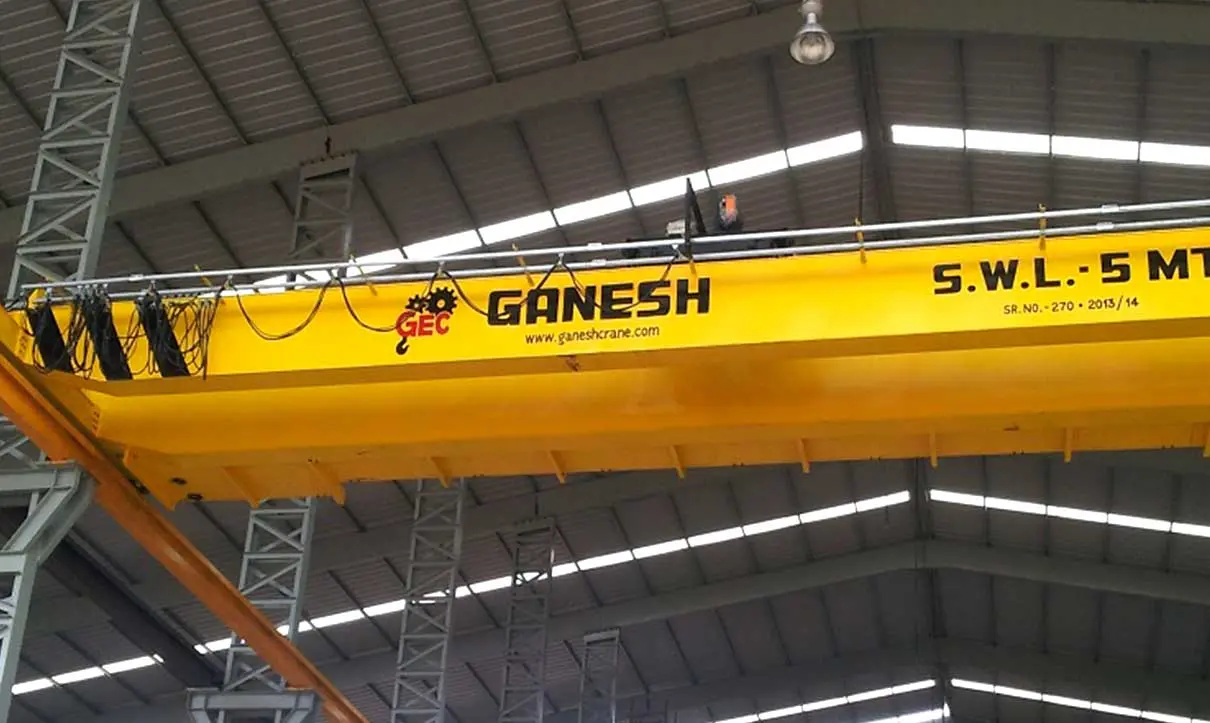
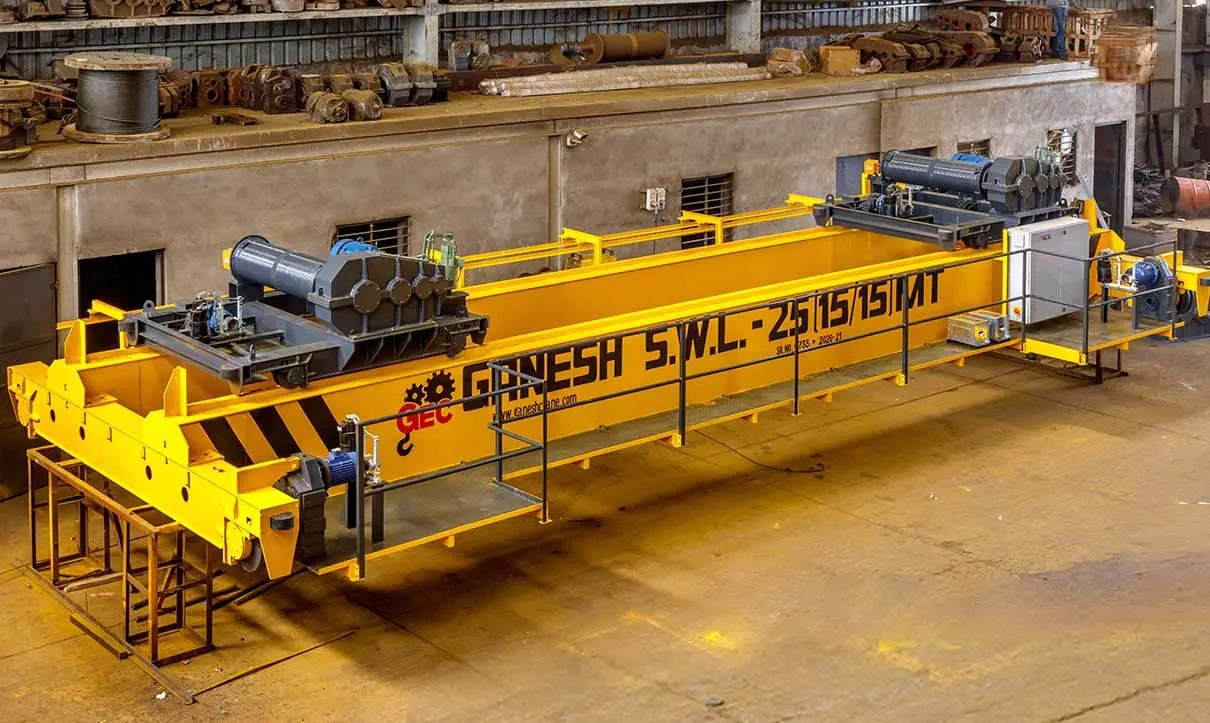
Types of EOT Cranes We Manufacture
EOT Crane Applications
Our industrial cranes serve a wide range of heavy industries, including:
- Steel Plants and Rolling Mills
- Foundries and Forge Shops
- Automobile and Engineering Industries
- Chemical and Petrochemical Plants
- Cement and Ceramic Industries
- Textile Mills
- Power Plants (Thermal and Hydro)
- Construction Equipment Manufacturing
- Dairy and Food Processing Industries
- Hydrocarbon Processing Units
- Paper and Pulp Industries
- Defense and Heavy Engineering Units
Why Choose Us for the Best Quality EOT Crane?
20+ Years of Experience
We've been making material handling equipment since 2004, with real, hands-on knowledge of the steel, automobile, and heavy engineering sectors.
IS Standard Compliant
Every crane is designed and tested against IS:807 and IS:3177, meeting the safety standards Indian industry requires.
Custom Engineering
Before we build a crane, we look closely at your load type, duty cycle, bay conditions, and site environment.
In-House Manufacturing
Gearboxes and structures are built at our own Ahmedabad facility, giving us tighter control over quality, delivery time, and spare parts.
Pan-India Supply and Export
We deliver and install cranes across India, and overseas too, wherever your facility happens to be.
Genuine After-Sales Support
Installation, AMCs, breakdown support, and spare parts, available for as long as your crane stays in use.
Manufacturing is only part of what we do. We’re also recognized among the trusted EOT Crane Suppliers in India, supplying and installing different types of cranes across the country. From the steel and engineering hubs of Gujarat and Maharashtra, to automobile centres in Tamil Nadu, to industrial belts in North and East India, our reach covers it all.
Need just one crane for a new facility, or a whole fleet for a multi-bay plant? Either way, we take care of design, fabrication, transport, installation, and commissioning ourselves, start to finish.
Our job doesn’t end at delivery. As one of the established EOT Crane Suppliers, we stay in touch well after that — keeping spare parts stocked, and running planned maintenance so your production line doesn’t hit unplanned downtime.
Our reach isn’t limited to India either. We’re counted among the EOT Crane Exporters supplying units to clients in Asia, Africa, and the Middle East. Every export order gets engineered around that country’s site conditions, power supply standards, and safety codes — and we handle the documentation and shipping ourselves, so nothing gets stuck at your end.
Strong supply within India, backed by real export experience — that’s a fairly rare combination, and it’s what sets us apart among EOT Crane Exporters in India. We’d rather be a long-term partner to our clients, Indian or overseas, than just another one-time vendor.
A crane is a long-term asset for your plant, and how well it performs over the years comes down to maintenance just as much as build quality.
Our support starts at installation itself. Our own team carries out the on-site installation and commissioning, so the crane is fitted correctly from the start.
Once the crane is in operation, we offer structured crane AMC (annual maintenance contract) plans. Under an AMC, the crane gets regular check-ups, so small issues get caught before they turn into a breakdown. And if something does go wrong, our team steps in with breakdown assistance to get things moving again quickly.
We build our own gearboxes and structural parts in-house, so spare parts are always available when needed. There’s no long wait on outside suppliers, and that alone saves a lot of downtime.
This is what our support looks like in practice — steady maintenance behind a crane that keeps working, year after year.
Frequently Asked Questions
What is the full form of EOT Crane?
EOT means Electric Overhead Traveling. Simply put, it's a crane that runs on electricity along a fixed track set up high inside a factory, warehouse, or shed. Some people call it a bridge crane, others say overhead crane — same thing. It's one of the most common lifting solutions you'll find in Indian industry.
What is the difference between a Single Girder and Double Girder EOT Crane?
A single girder crane has just one bridge beam. It's built for lighter loads, normal-duty work, up to around 20 tons. A double girder crane has two beams side by side instead. That extra beam means it can lift heavier loads, gives more hook height, and copes better with continuous, heavy-duty lifting.
What is the maximum lifting capacity available?
Our cranes typically lift between 1 ton and 100 tons, depending on the design, span, and duty class chosen. For unusually heavy loads, we can also engineer custom solutions with reinforced structures and higher-rated parts.
Can I get a customized EOT bridge crane?
Yes — every crane we build is made to order rather than off-the-shelf. Span, capacity, duty class, hook height, working environment, and bay conditions all get factored into the design, so the crane fits what you actually need rather than the other way around.
Do you help with EOT crane installation and maintenance?
Yes. We handle on-site installation and commissioning, offer AMCs so the crane keeps running smoothly, and jump in with breakdown help whenever it's needed. Spare parts stay stocked too, so a replacement doesn't mean a long wait.
What is the EOT crane price in India?
Price depends on capacity, span, hook height, duty class, and the features you go with. Single girder cranes usually work out cheaper. Double girder cranes cost more, simply because they lift more and need a stronger build. Since each crane is custom-built, get in touch with your requirements for an accurate, no-obligation quote.
Which industries use EOT Cranes the most?
Steel plants, foundries, automobile and engineering companies, chemical and petrochemical units, cement and ceramic plants, textile mills, power plants, and paper industries all rely on overhead traveling cranes regularly. In short, any factory moving heavy material — raw stock through to finished goods — needs an overhead crane somewhere in the process.
How do I choose the right overhead crane capacity and duty class?
Start with your heaviest regular load, and build in some safety margin on top of that for capacity. For duty class, look at how many hours a day and how many lifts per hour the crane will actually perform — that matters just as much as the tonnage itself.
How much weight can an EOT crane lift?
Between 1 ton and 100 tons, depending on span, duty class, and the structural configuration you go with. Standard loads are usually well within reach of a single girder crane. For heavier, non-stop lifting, double girder is the way to go.
What is the lifespan of an electric overhead traveling crane?
With regular maintenance, genuine spare parts, and the right duty class chosen at the design stage, an electric overhead traveling crane usually runs reliably for 20 to 25 years, sometimes longer. A lot comes down to how it's used and serviced — a crane run within its rated capacity and maintained on schedule will easily outlast one that's overloaded or neglected.
Do you supply EOT cranes outside India?
Yes. Alongside our pan-India supply, we also export overhead cranes to international markets, and we take care of the documentation and logistics involved.
What crane span options are available?
Crane span typically ranges from 5 metres to 50 metres, depending on your bay width. We take a look at your site conditions first, then design the bridge to match — so the crane fits your building without any adjustment needed on your end.
How is crane duty class decided?
Crane duty class (Class I to Class IV) comes down to how often the crane lifts and how many hours a day it runs. A crane used a handful of times a day needs a lighter duty class than one running continuously in a foundry or steel plant. We help you work out the right one based on your actual usage.
What safety features come standard on an EOT crane?
Every crane comes standard with a limit switch that stops over-hoisting or over-lowering, a hook safety latch, overload relays, a travelling limit switch, rubber buffers, brakes on all motions, a main switch with emergency stop, MCB/fuse protection, 4-core earthed cables, and a maintenance platform. Goliath cranes also get a siren and an anti-collision device. None of this costs extra — safety is part of the standard build.