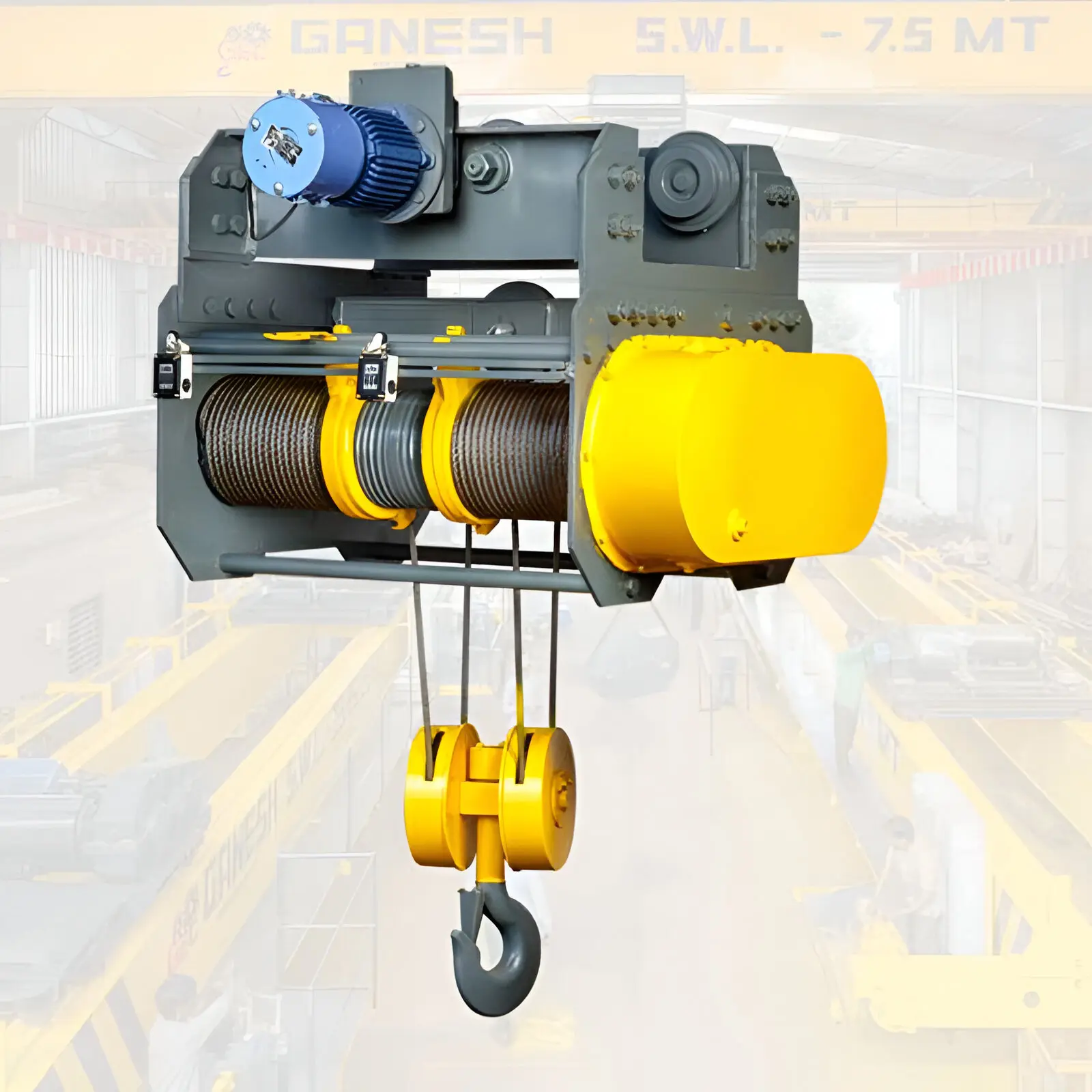
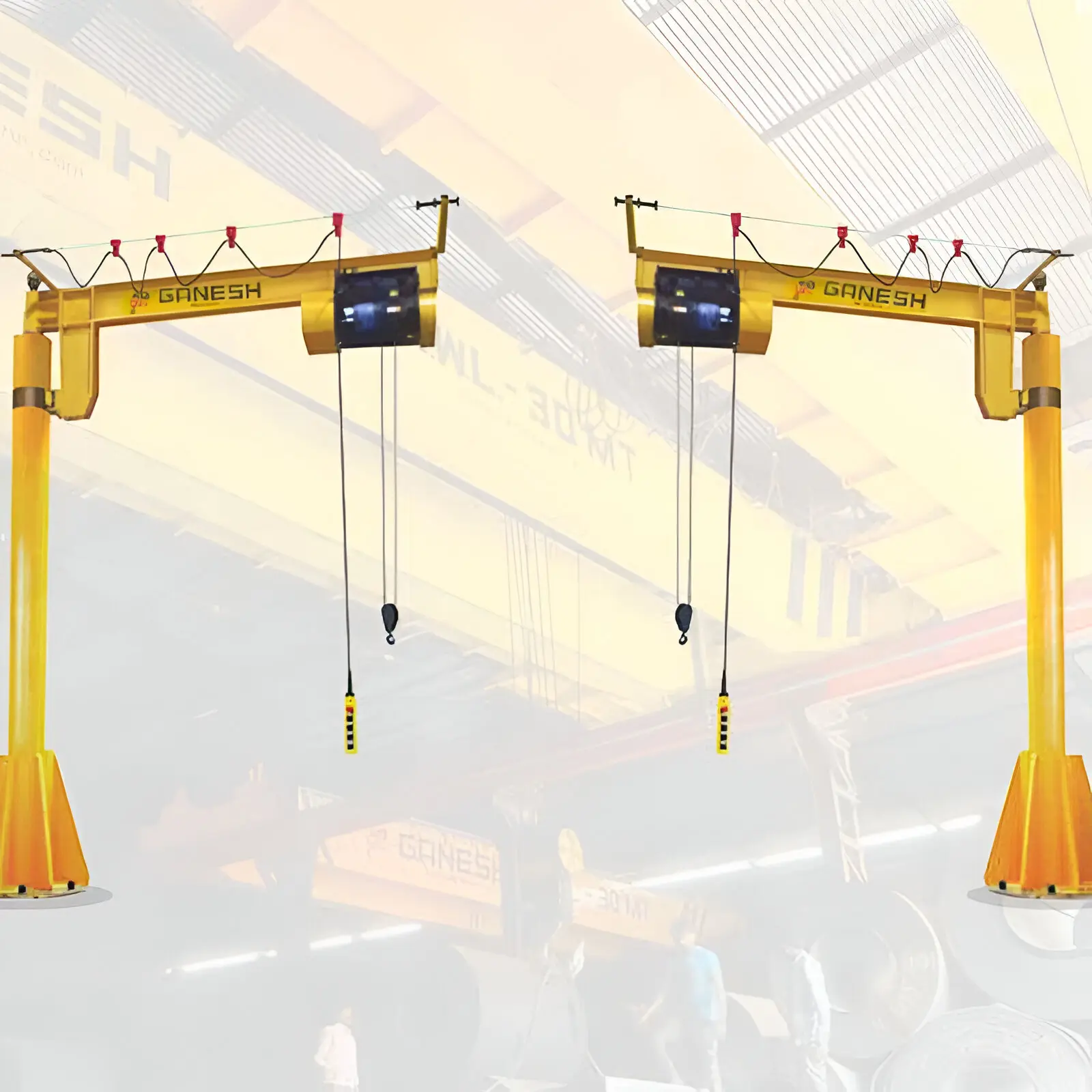
JIB Crane
4.5-6 m
1ton to 5ton
Class-I to Class-IV (M1-M8)
Floor operated through pendent pushbutton station (Optional remote or cabin Operated)
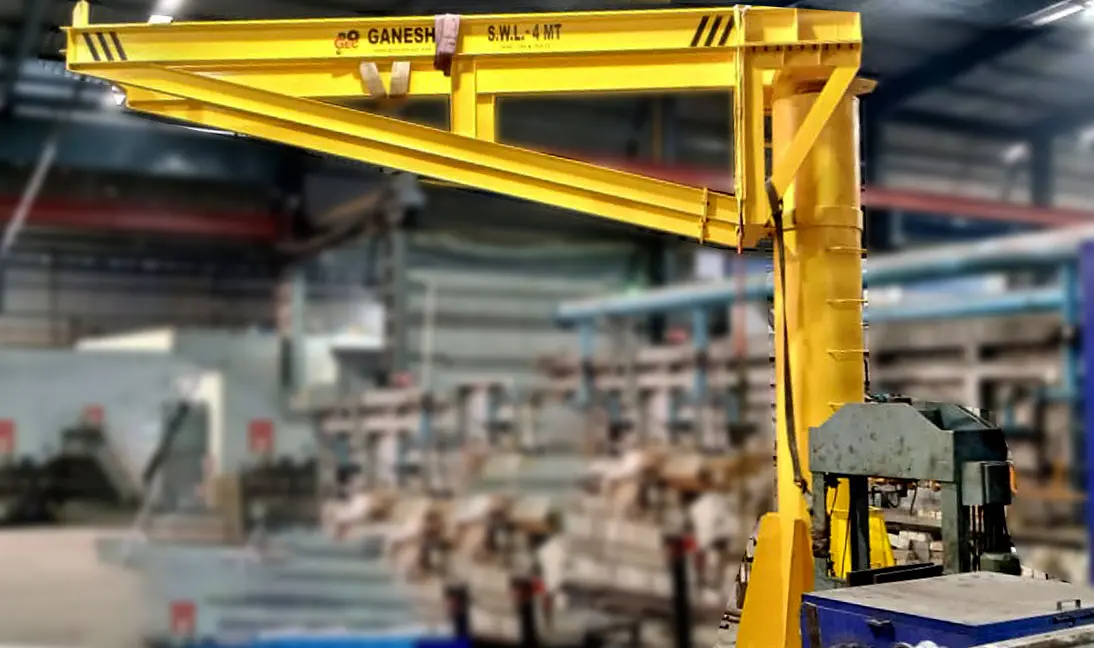
What is JIB crane?
The horizontal or vertical beam is used in many types of cranes. These cranes are used to support the load clear of primary support.Jib cranes are used with arms attached to a vertical mast or sometimes to an inclined boom. We are one of the best JIB cranes manufacturers in India.
Jib cranes are an economical solution for moving materials within an individual workstation, for transferring materials from the work area to another work area, or for serving as auxiliary lifting devices under overhead cranes. There are Styles range from entirely self-supporting to styles that mount to existing building columns, resulting in low costs compared to some overhead lifting systems. Because they are self-supporting, freestanding jib cranes are well suited for outdoor use and can be fully weatherized.
We have known about working in this field for many years. It’s been a long time since we have been making products. Our products are tested at every stage of making the crane and tested before giving it to the client. We take care of the client and their requirements, even after delivering our products. We are one of the biggest JIB crane suppliers. We provide the cranes at very effective prices, and we have always been sure and guarantee our work on the client’s requirement basis. We will assist you and give our best JIB cranes.
Other Details of the JIB Crane
- Manufacturing Range
- Specifications
- Standard Features
- Optional Features
- Safety
- Packing & Forwarding
- Pre-Sales Service
- After-Sales Service
- Manufacturing Range
- 1t. to 5t. Cap., up to 5-meter Span and 6 meter height of lift (for Higher Capacity and lift please consult us)
- 1t. Cap. Jib Crane
- 2t. Cap. Jib Crane
- 3t. Cap. Jib Crane
- 4t. Cap. Jib Crane
- 5t. Cap. Jib Crane
- Specifications
- Standard Features
- Modular Design
- CNC Plasma Cut Plates
- Flange Mounted Motors in hoist and CT
- Higher efficiency to save power
- All motions are protected with Fail safe type brakes (which are applied when power supply is off and release when power supply is on.)
- All motions are protected with limit switches
- Dustproof panel box with reputed make switch gear or as per customer’s approval
- 110 V Control voltage selected for protection of Crane operator against any electrical shock
- With electrical Interlocking to prevent simultaneous operation of opposite motion
- Unbreakable, Handy, light weight PVC Pushbutton
- Own Make Gearbox so which are easy to maintenance and we can provide any parts at any time from our stock
- Optional Features
- Radio Remote Control
- Dual speed for all motion
- VFD in all motion
- Siren While Traveling a Hoist
- Load Cell with Display to weigh a Load or protection against overload
- Special Dimension Hook
- Other Reputed Brand Gearbox
- Protective Paints / Coating
- Safety
- Over Lowering or over hoisting prevention limit switch
- Hook Safety Latch
- Overload Relays
- Travelling limit switch
- Brakes in Hoisting as well as c.t
- On/ off switch in push button /Emergency stop
- MCB /fuse
- All 4 core cables with Earth cable
- Packing & Forwarding
- Pre-Sales Service
- One to one service guarantees you the best purchasing experience.
- Strong production capacity and professional workmen guarantee you the short delivery.
- Strict delivery inspection guarantees you the high quality products.
- The short delivery time.
- After-Sales Service
- One year warranty for Cranes
- Providing free quick-wear part
- Low charge for continue maintenance when warranty is expired
- Exclusive engineer support at any time.
- Highly professional training to end-users
| Descriptions | Specifications |
| Area | Non Hazardous/Hazardous as per customer requirement |
| Test Load | 125% of SWL |
| Height of Lift | 2 meters to 6 meters or as per customer requirements |
| IS Code | IS3177, IS3937 |
| Type | Wall Mounted / Pillar Mounted |
| Locations | Indoor/Out door |
| Main-Hoisting | 1 to 3.5 meter per minute (micro speed will be provided on demand) |
| C.T. | 5 to 15 meters per minute (micro speed will be provided on demand) |
| Ele. Motors | All motors are off S-4 duty, Squirrel cage ,40% CDF,150 S/hr., IP -55 with Class F insulation or as per required class and duty |
| Brakes | Electro Hydraulic shoe type/ Electromagnetic Disc / Electromagnetic Shoe type brake shall be provided in Hoisting & C.T. These brakes are automatically released when the motor circuit is on and is applied the motor circuit is off |
| Wire Rope & No. of fall | Selected as per crane capacity and IS Code he make of wire rope will be used Usha-martin |
Electric & Small parts are packed by high quality wooden crate to reduce distortion in conveying; Main beams, end carriages and electric hoist are packed by Wrapping of plastic roll It can reduce abrasion when transport.