

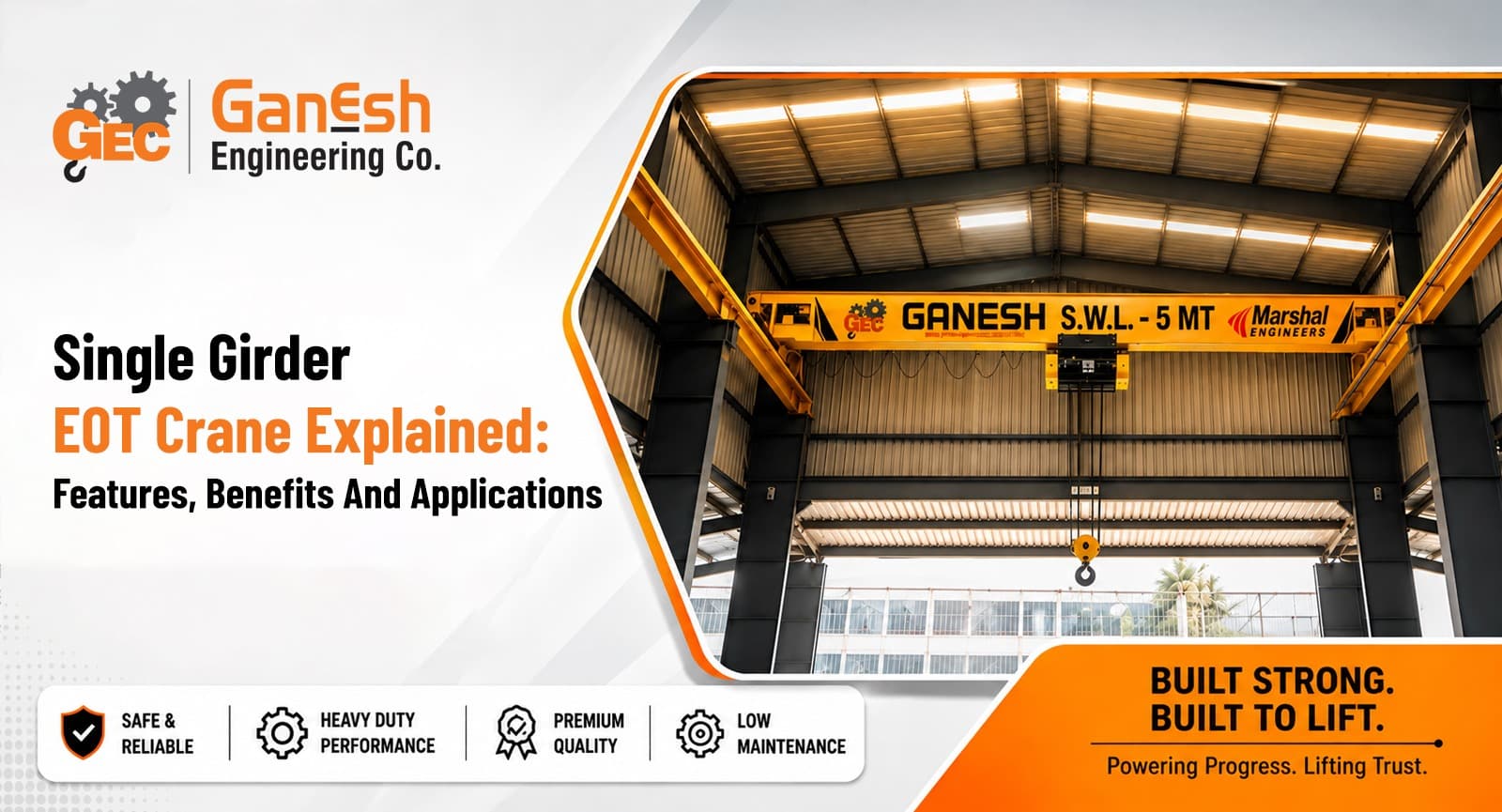
What is a Single Girder EOT Crane?
A Single Girder EOT Crane gets its name from the single main beam, or girder, that carries the hoist and trolley. This girder sits on top of the end trucks and moves along a runway beam that’s fixed to the building’s columns or structure.
A double girder crane uses two beams working together for added strength. A single girder overhead crane does the same job with just one beam, which keeps things lighter and more compact. That’s a real advantage in buildings where the ceiling height doesn’t leave much room to work with.
Most of these cranes handle light to medium duty lifting, and while the exact number depends on span and design, capacity typically goes up to around 20 tons.
Key Features of a Single Girder EOT Crane
There’s nothing overly complicated about a single girder electric overhead traveling crane, and that’s part of its appeal. A few things stand out when you look at how it’s built:
- It has a compact design that doesn’t eat up much headroom, unlike double girder setups
- The structure is lightweight, so it puts less strain on the building it’s installed in
- An electric hoist runs along the bottom flange of the girder, giving smooth up-and-down movement
- Installation and upkeep are fairly straightforward, which saves both time and labor cost down the line
- Lifting speed and travel speed can be adjusted to match how the crane is actually being used
- Built-in safety features, including limit switches, overload protection, and emergency stop buttons, come standard
- Operators can control it through a pendant or remote, so they’re not standing directly under the load
Benefits of Using a Single Girder EOT Crane
Ask any facility manager why they went with a single girder bridge crane, and cost usually comes up first. But that’s not the only reason it’s a popular pick:
- It costs less. One girder instead of two means lower material and fabrication expenses right from the start.
- Setup is quicker. A simpler structure translates to faster installation and less production downtime.
- It saves space. If your building has a lower ceiling, this crane needs far less clearance than a double girder version.
- It’s lighter on the building. Less dead weight means less stress on the structure, and sometimes lower construction costs too.
- Maintenance is simpler. Fewer parts mean fewer things that can go wrong, and cheaper upkeep over the years.
- It uses less power. A lighter crane generally consumes less energy during day-to-day operation.
If your lifting needs aren’t extremely heavy, this crane gives you a solid mix of performance and value without overspending.
Applications of Single Girder EOT Cranes
You’ll find a single girder overhead crane doing its job across all kinds of industries, not because it’s flashy, but because it simply works well for moderate loads. Some places where it’s commonly used:
- Small and medium-sized manufacturing units
- Automobile parts and assembly workshops
- Warehouses and storage facilities
- Steel fabrication units
- Machine shops and tool rooms
- Textile and paper mills
- Cement and packaging plants
In short, if a facility needs to shift materials, machinery, or finished goods around and doesn’t have unlimited ceiling height or extremely heavy loads to deal with, this crane type is usually a good fit.
For a broader look at how overhead cranes work across different industries and duty classes, this guide on everything you should know about EOT cranes is worth a read.

Before specifying a single girder EOT crane, a few parameters need to be confirmed:
| Capacity | The maximum load the crane will need to lift, with a safety margin above the heaviest expected lift. |
| Span | The distance between the runway rails; this determines the beam length and affects deflection under load. |
| Lift Height | The maximum height the hook needs to travel; this should be confirmed against the building height and the available under-beam clearance. |
| Duty Class | Indicates how frequently the crane will lift and the load spectrum it will handle. Duty classes range from M1 to M8, covering most standard workshop and light industrial applications. |
| Control Method | The method used to operate the crane. A pendant pushbutton is suitable for standard use, while a radio remote is preferred when the operator needs freedom to move away from the crane. |
Working with an experienced single girder crane supplier who asks these questions before quoting – rather than just taking a size and capacity off a list – is what determines whether the crane actually fits the application.
Source Single Girder EOT Cranes from Ganesh Engineering Co.
Ganesh Engineering Co. manufactures single girder EOT cranes across capacities from 1 tonne to 10 tonnes, with spans up to 10 metres and duty classes M1 to M8 – designed to IS:807 and IS:3177 standards, with custom engineering for specific span, lift height, and duty requirements, and full installation and commissioning support across India.
Frequently Asked Questions

Ganesh Engineering
Ganesh Engineering Co. has been a leading manufacturer of Materials Handling Equipment in India since 2004. In order to provide top-notch products and services, our experienced and dedicated team utilizes the latest technology to achieve perfection.