

Quick Summary
A double girder floor running goliath crane is a large gantry-type crane with two main beams, supported on legs that travel on ground rails. It lifts heavy and long loads in open yards, shipyards, steel plants and power projects, where no building is available to carry the crane. It offers high capacity, long spans and good lifting height. This guide explains how it works, the main types, uses and the points to check before you buy.
Table of Contents
What Is a Double Girder Floor Running Goliath Crane?
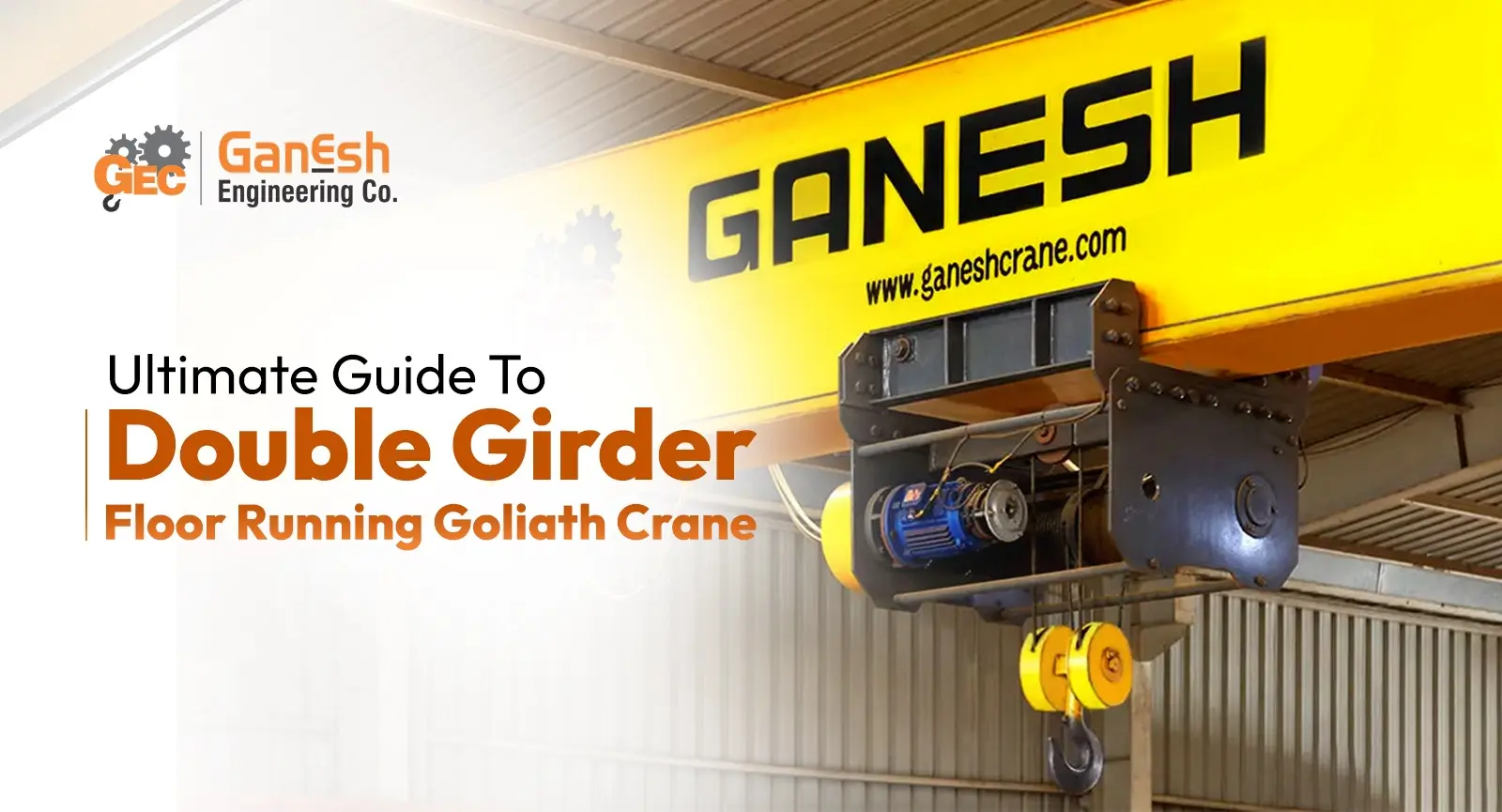
It is a heavy-duty lifting machine made of two parallel girders, joined by end carriages and carried on two tall legs. The legs run on rails laid on the ground, which is why it is called floor running. A hoist trolley moves along the girders and lifts the load.
In India, the word “goliath” is commonly used for large gantry cranes. A double girder floor running goliath crane is chosen when the load is too heavy, the span too wide or the lifting height too great for a lighter crane.
The problem it solves is simple. Many heavy industries work in the open, or in sheds that cannot carry a crane runway. Moving massive plates, castings, girders or equipment with trucks and forklifts is slow and risky. A goliath crane brings its own support structure, and it covers a large area with one machine.
The Working Process of Goliath Crane
Here is the simple working process of the double girder floor running goliath crane.
- The operator uses a cabin, a pendant or a radio remote.
- The hoist lifts or lowers the load, using wire ropes and a hook, a grab or a spreader beam.
- The trolley travels along the two girders, which moves the load across the span.
- The entire crane travels on the ground rails, which moves the load along the yard.
- Limit switches, overload protection and brakes keep each movement within safe limits.
By combining these three motions, the operator can place a load almost anywhere under the crane.
Main Parts of the Crane
- Main girders: two box-type or truss beams that carry the trolley and the load.
- End carriages: connect the girders to the legs, and house the wheels and drives.
- Legs: the vertical supports. One is often rigid, and the other can be flexible to handle small misalignments in the rails.
- Trolley and hoist: the lifting unit that travels on top of the girders.
- Long travel drive: geared motors that move the crane along the rails.
- Ground rails and stoppers: the track on which the crane runs.
- Power supply system: a cable reel, a festoon or conductor bars.
- Operator cabin or controls: a cabin, pendant or radio remote.
- Safety devices: limit switches, overload limiter, buffers and rail clamps.
Types of Double Girder Floor Running Goliath Crane
- Full goliath crane: both legs run on ground rails. This is the common type for open yards.
- Semi-goliath crane: one leg runs on a ground rail, and the other runs on a raised runway fixed to a building or a wall.
- Cantilever goliath crane: the girders extend beyond the legs, so the hook can reach outside the rail track, for example over a ship or a trailer.
- Open winch trolley type: a heavy-duty trolley with a winch, used for very large loads.
- Hoist trolley type: a lighter trolley with a wire rope hoist, used for moderate heavy loads.
- Box girder and truss girder designs: box girders are strong and compact, and truss girders are lighter for very wide spans.
Double Girder vs Single Girder
The number of girders affects strength, lifting height and cost.
- Single girder: one beam, lower cost and lighter weight. It suits light to medium loads.
- Double girder: two beams, a stronger structure and a trolley that sits on top. It gives more lifting height, handles higher capacity and longer spans, and offers room for walkways and bigger trolleys.
If your loads are heavy, your span is wide or your duty is heavy, a double girder floor running goliath crane is usually the safer choice.
Where It Is Used
- Steel plants and stockyards: moving billets, coils, plates and finished steel.
- Shipyards and ports: handling hull sections, machinery and cargo.
- Precast and construction yards: lifting concrete beams, slabs and bridge girders.
- Power plants and hydropower projects: erecting and servicing turbines, generators and large components.
- Heavy fabrication and engineering units: assembling large structures.
- Railway workshops and yards: lifting coaches, bogies and equipment.
- Foundries and forging plants: handling castings and heavy dies.
- Pipe, cable and equipment yards: moving long and bulky items.
- Scrap and bulk handling: with a grab or a magnet attachment.
Benefits of Double Girder Goliath Crane
- High capacity: it can lift much more than light-duty cranes.
- Wide coverage: a long span and a long runway cover a large area.
- Good lifting height: the top-running trolley gives extra hook height.
- Independent structure: no building is needed.
- Flexible attachments: hooks, spreader beams, grabs and magnets can be used.
- Customisable: span, height, cantilevers and controls can be matched to the site.
- Stable and strong: a double girder frame resists bending and twisting.
How to Choose the Right Crane
Use this checklist when you speak to a supplier.
- Maximum load: include the weight of lifting beams, grabs or magnets.
- Span and lifting height: measure the yard and the tallest load.
- Cantilever need: decide whether you need to reach outside the rails.
- Duty cycle: how many hours a day and how many lifts per hour.
- Location: outdoor cranes need protection from weather and wind.
- Rail track and foundation: check the ground, the rail length and the drainage.
- Power supply: the available voltage and the way the power reaches the crane.
- Control type: a cabin for long shifts, or a remote for flexibility.
- Attachments: the tools you will use under the hook.
- Safety features and standards: overload limiter, limit switches, rail clamps and compliance.
- Support: installation, load testing, training, spares and service.
Conclusion
A double girder floor running goliath crane is a reliable choice for heavy lifting in open yards and areas without a building runway. Choosing the right capacity, span, duty class and safety features at the start helps you avoid problems later. If you need quality cranes in standard or customised sizes, you can get in touch with Ganesh Engineering Co., a manufacturer and supplier known for quality products and technical support.
Frequently Asked Questions
What is a goliath crane?
It is a large gantry crane that has its own legs and travels on ground rails, used to lift heavy loads in yards and open areas.
What is a double girder floor running goliath crane?
What is the difference between a goliath crane and an EOT crane?
What is the difference between single girder and double girder goliath cranes?
What capacity can a double girder goliath crane lift?
Where are goliath cranes used?
How do I choose the right goliath crane?
How often should a goliath crane be inspected?

Ganesh Engineering
Ganesh Engineering Co. has been a leading manufacturer of Materials Handling Equipment in India since 2004. In order to provide top-notch products and services, our experienced and dedicated team utilizes the latest technology to achieve perfection.